
What determines sea freight costs and how are shipping rates calculated? Explore the key factors affecting ocean freight rates, additional charges, and how to request and compare shipping quotes through Searino.
When planning to ship goods by sea, one of the first questions that comes to mind is: How much will sea freight cost, how do shipping companies calculate their rates, and are there any additional charges to pay after the initial quote is issued?
When arranging sea freight, you may receive different quotations from several shipping companies or freight forwarders for the same route. However, the quoted amounts may vary. This does not necessarily mean that one company is more expensive than another without reason. Factors such as cargo type, weight and volume, required equipment, shipping route, origin and destination charges, and the services included in each offer all influence the final rate. These factors need to be reviewed carefully before making a decision.
Sea freight costs vary depending on the type of cargo. The cargo itself, its packaging, and even the type of vessel or equipment required can affect the shipping price. For example, the cost of shipping several pallets of industrial spare parts is different from the cost of transporting a steel shipment or bulk cargo. Even when two shipments are transported between the same origin and destination ports, differences in their specifications can result in different freight quotations.
That is why calculating sea freight costs requires more than simply looking at the vessel's base freight rate. You need to understand which charges are included in the quotation, what information is required to receive an accurate offer, and how to compare the prices provided by different shipping companies.
In this guide, we explain the main components of sea freight costs, the factors affecting shipping rates, how pricing varies by cargo type, and how to request quotations from shipping companies. We also introduce Searino's maritime freight platform and its freight marketplace, where you can submit your shipment details and receive quotations from different service providers.
What Are the Main Components of Sea Freight Costs?
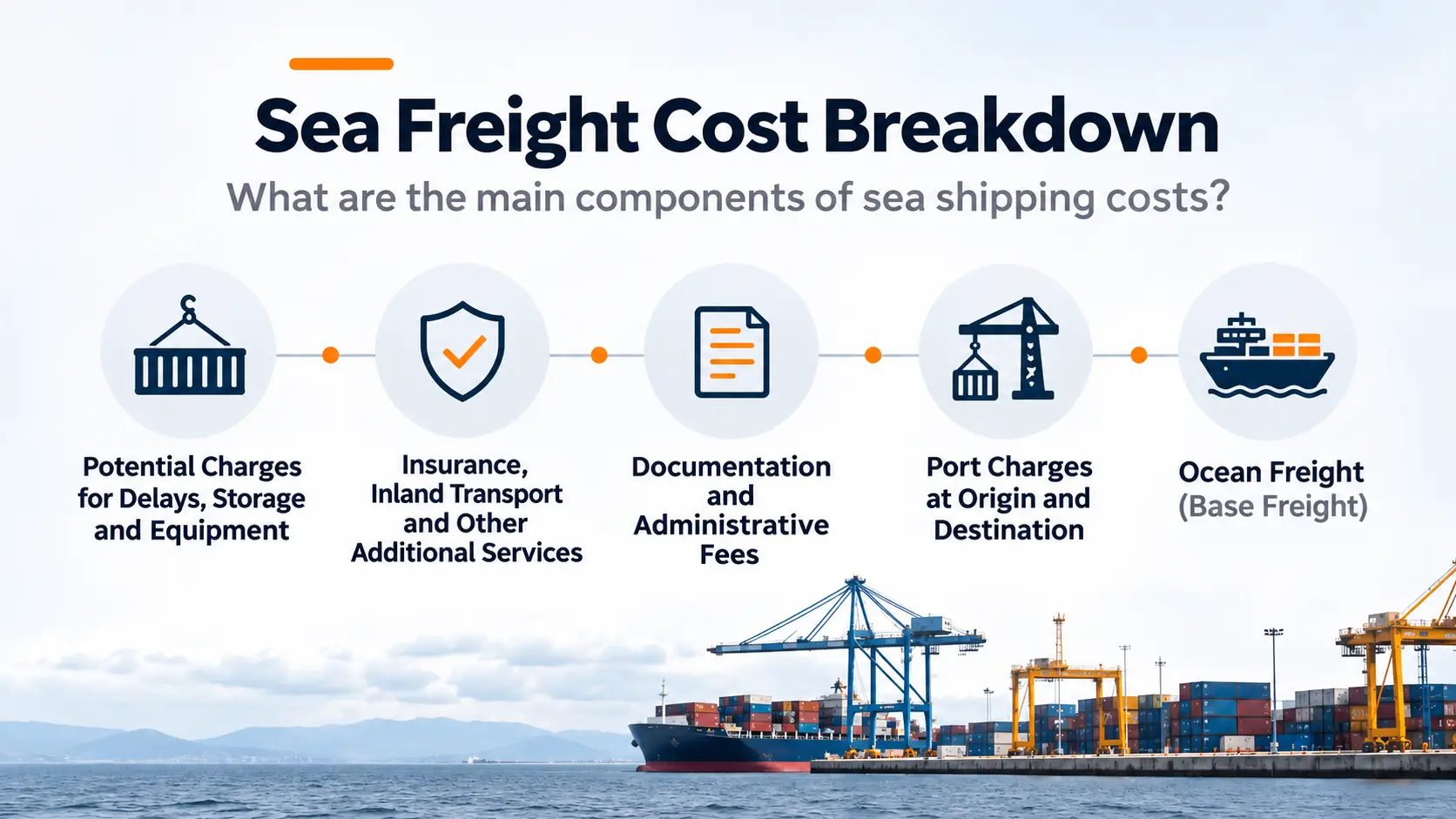
Sea freight costs generally consist of several components. Some are related to the actual transportation of cargo by vessel, while others involve port services, loading and unloading operations, or additional services. These charges should be identified separately and clearly stated in the final cost breakdown.
To avoid confusion when requesting a sea freight quote, it is important to understand the different charges that may apply.
Basic Ocean Freight
Ocean Freight refers to the base charge for transporting cargo from the Port of Loading (POL) to the Port of Discharge (POD).
It is one of the main components of a shipping quotation and is determined by factors such as the shipping route, type of service, cargo specifications, available vessel capacity, and overall market conditions.
For example, the freight rate from Shanghai to Bandar Abbas may differ from the rate for shipping cargo from Jebel Ali to Bandar Abbas. Different contract terms and service conditions may also lead to different quotations from shipping companies operating on the same route.
It is important to understand that the base ocean freight rate does not necessarily cover all transportation costs. When requesting a quotation, confirm with the shipping company whether the quoted amount covers only ocean transportation or includes additional services as well.
Origin and Destination Port Charges
Some shipping expenses are related to services performed at port terminals. These charges may apply at the origin port, the destination port, or both.
One of the most common terms in this category is THC (Terminal Handling Charge). It refers to the charges associated with terminal handling operations, including the handling and movement of cargo or containers within a port terminal.
For LCL shipments, additional charges such as CFS fees may also apply for consolidating cargo at the origin or deconsolidating it at the destination.
The amount and application of these charges depend on the port, type of service, contract terms, and service provider. Therefore, when requesting a quotation, make sure to ask whether origin and destination port charges are included in the quoted price or payable separately.
Documentation and Administrative Charges
Shipping operations may require various documents to be issued or processed. Charges for preparing and managing the Bill of Lading, documentation services, and other administrative procedures may be included in the quotation or final invoice.
These fees vary depending on the type of service, the provider, and the agreed contract terms.
When reviewing a freight quotation, ask the shipping company to specify documentation and administrative charges. This helps prevent unexpected fees that were not clearly mentioned in the initial offer.
Insurance, Inland Transportation, and Other Additional Services
Depending on the scope of services requested, additional expenses may include cargo insurance, inland transportation from the shipper's location to the origin port, delivery from the destination port to the consignee's warehouse, or other specialized services.
These services are not necessarily included in the basic ocean freight rate.
For example, when a quotation covers port-to-port transportation only, you should not assume that transportation from the seller's warehouse to the origin port or from the destination port to the receiver's warehouse is included.
Potential Charges for Delays, Storage, and Equipment
Some expenses cannot be determined when the initial shipping request is submitted. They may arise only if specific circumstances occur.
For example, if a container remains at the terminal beyond the permitted free time or is not returned to the shipping company on time after leaving the port, charges such as Demurrage or Detention may apply.
For bulk and general cargo shipments, loading and unloading operations, vessel waiting time, and contractual terms may also affect the final cost.
Therefore, when comparing freight quotations, do not only review the confirmed charges. Ask about the conditions under which additional expenses may apply as well.
What Factors Affect Sea Freight Costs?
After understanding the main components of sea freight costs, the next step is to identify the information shipping companies review when determining their rates.
These details help them evaluate the space required, necessary equipment, operational time, and specific transportation conditions of each shipment.
Freight rates vary according to several factors. A higher quotation from one shipping company does not necessarily mean that the company is charging an unreasonable price.
According to UNCTAD's Review of Maritime Transport 2025, freight rates across container shipping, dry bulk, and tanker markets experienced considerable fluctuations during 2024 and 2025. Geopolitical tensions, changes in shipping routes, available transport capacity, and operating costs can all contribute to rate volatility. Longer maritime routes and reduced effective shipping capacity can also increase transportation costs.
For more details, see Chapter 3 of UNCTAD's Review of Maritime Transport 2025.
The following sections explain the main factors affecting sea freight rates.
Origin and Destination Ports
The ports of loading and discharge are among the first factors considered when determining sea freight rates.
The origin and destination ports determine the available shipping routes, the services operating on those routes, and whether the cargo needs to be transferred through an intermediate port.
For example, a shipment may be transported directly on one route, while another route may require transshipment, meaning the cargo is transferred from one vessel to another before reaching its destination.
The number of stops, vessel schedules, available capacity, and port operating costs can all affect both freight rates and transit time.
For this reason, provide the exact names of the origin and destination ports when requesting a quotation. Specifying only the countries may not provide enough information for an accurate offer.
Cargo Type and Shipment Specifications
Shipping companies need to know exactly what type of cargo they are transporting because different goods have different handling, storage, and transportation requirements.
For example, ordinary industrial components may require different equipment from chemicals, temperature-sensitive goods, or dangerous cargo.
Depending on the nature of the goods, special documents, packaging, permits, or equipment may also be required.
When submitting a freight request, provide an accurate description of your cargo. General descriptions such as "industrial goods" or "commercial cargo" may not be sufficient to evaluate the actual transportation requirements.
For example, transporting fresh apples may require a refrigerated container with a controlled temperature, whereas a shipment of ordinary steel products may be suitable for a standard container. Differences in container type and size can affect the overall sea freight cost.
Cargo Weight, Volume, and Dimensions
Cargo weight and volume are among the main details required for freight pricing.
Shipping companies and freight forwarders use this information to determine how much space the shipment requires, which transportation method is suitable, and whether there are any weight or dimensional restrictions.
For example, two shipments with the same weight may have completely different volumes. A dense shipment may occupy relatively little space, while a bulky shipment with the same weight may require much more space on a vessel or within the transportation equipment.
Therefore, provide the total cargo weight, the number of packages, and the dimensions of each package.
The total cargo volume, measured in cubic meters (CBM), is also an important factor in calculating rates for certain sea freight services.
Shipping Method and Required Equipment
The basis for calculating sea freight costs also depends on the transportation method.
For example, the cost of shipping a dedicated container is different from the cost of transporting consolidated cargo.
In container shipping, the container type and size, as well as the choice between FCL and LCL, are important. For bulk cargo, the shipment tonnage and vessel capacity are considered. For general and project cargo, dimensions, individual cargo weights, lashing requirements, and loading equipment may influence the price.
If your shipment requires containerized transportation and you would like to learn more about container types, dimensions, and the differences between FCL and LCL, read our guide: What Is Container Sea Freight?.
Cargo Readiness Date and Available Vessel Capacity
The date on which your cargo will be ready for loading is another important factor when evaluating freight rates.
Shipping companies review vessel schedules and available capacity to determine whether they can provide the requested service.
As a result, quotations for the same route may differ depending on the planned shipping date.
If your shipment has a specific delivery deadline, provide an accurate cargo readiness date and check how long the quotation remains valid.
Origin and Destination Charges and Scope of Services
One of the main reasons shipping companies may offer different rates for the same shipment is that their service coverage may not be identical.
One company may quote only the ocean freight charge, while another may include some origin or destination port charges and additional services.
You should also clarify which part of the transportation process is covered by the requested service. Does the quotation cover port-to-port transportation, transportation from the cargo pickup location to the destination port, or delivery all the way to the final destination?
For an accurate comparison, always compare quotations that cover similar services and responsibilities.
How Are Sea Freight Costs Calculated for Different Cargo Types?
One important consideration when requesting a freight quotation is that the pricing method is not the same for every type of cargo.
The nature of the goods and the transportation method determine the basis on which the service provider calculates the rate.
How Are FCL Container Shipping Costs Calculated?
Under FCL (Full Container Load) shipping, a container is reserved exclusively for one shipper's cargo.
For this reason, the base freight rate is generally quoted according to the container type and size, as well as the shipping route.
For example, the rate for a 20-foot container may differ from the rate for a 40-foot or 40-foot High Cube container.
Even if part of the container remains empty, the base rate for the reserved container does not necessarily decrease in proportion to the unused space.
To estimate the cost, consider the container type, origin and destination ports, cargo specifications, and additional charges.
How Are LCL Shipping Costs Calculated?
Under LCL (Less than Container Load) shipping, a shipment is consolidated with cargo belonging to other shippers in a shared container.
Instead of paying for an entire container, the shipper pays according to the pricing basis specified by the service provider.
In many LCL services, one common pricing method is W/M (Weight/Measurement). Under this method, the cargo weight and volume are compared, and the chargeable quantity is determined according to the applicable service tariff.
For example, imagine a shipment weighing 2 tons with a total volume of 3.5 CBM. If the service tariff uses a ratio of one cubic meter to one metric ton, the volume is greater than the weight, so the chargeable quantity may be 3.5 units.
This example is provided only to explain the W/M concept. The applicable ratio, minimum chargeable quantity, consolidation and deconsolidation fees, and other conditions must be checked against the specific service quotation.
How Are Bulk Cargo Shipping Costs Determined?
For bulk cargo, the freight rate depends on the shipment specifications and the operational conditions of loading and discharge.
Factors such as total tonnage, cargo type, vessel capacity, origin and destination ports, required equipment, loading and unloading rates, and contractual terms may all affect the quotation.
For example, when shipping minerals or dry bulk commodities, providing only the total tonnage is not sufficient. The nature of the commodity, its technical characteristics, and the facilities available at the ports must also be considered.
How Are General Cargo and Project Cargo Shipping Costs Calculated?
For general and project cargo, the dimensions and weight of each individual piece are especially important.
Two shipments with a similar total weight may require different equipment because of differences in shape, dimensions, or loading requirements.
For these shipments, the service provider may need information such as length, width, height, individual piece weight, total number of pieces, lashing points, and loading methods.
If the cargo exceeds standard dimensions, it may require dedicated space or specialized equipment. These requirements can affect the final quotation.
What Information Should You Prepare to Request a Sea Freight Quote?
One of the most important steps in obtaining a freight quotation is providing complete and accurate shipment details.
Imagine contacting a shipping company and simply saying, "I want to ship several pallets of industrial components from China to Iran."
This information is not sufficient for a reliable freight quotation.
The company needs to know the exact origin and destination ports, the cargo weight and volume, the type of packaging, and the date when the shipment will be ready for loading.
To help your request receive a more accurate response, prepare the following information:
What Information Should You Prepare to Request a Sea Freight Quote? | |
What Information Should You Prepare to Request a Sea Freight Quote? | |
What Information Should You Prepare to Request a Sea Freight Quote? | |
Required Information | Description |
|---|---|
Port of Loading (POL) | The port where the cargo will be loaded |
Port of Discharge (POD) | The port where the cargo will be discharged |
Commodity | A detailed description of the cargo and its characteristics |
Number of Packages | Total number of cartons, pallets, crates, or other units |
Gross Weight | Total cargo weight, including packaging |
Package Dimensions | Length, width, and height of each package |
Total Volume (CBM) | Total shipment volume in cubic meters |
Shipping Method | FCL, LCL, bulk cargo, general cargo, or another method, if known |
Cargo Readiness Date | The date when the cargo will be ready for collection and loading |
Special Requirements | Temperature control, special equipment, or stacking restrictions |
Documents and Photos | Invoice, packing list, cargo photographs, and technical documents, where applicable |
Why Are Complete Shipment Details and Documents Important?
Shipment details and documents help shipping companies and freight forwarders evaluate the cargo more accurately.
For example, if your shipment consists of several pallets with specific dimensions, providing accurate measurements helps the service provider assess the required space.
For sensitive or specialized cargo, relevant documents also help identify any additional transportation requirements.
If available, provide the packing list, cargo photographs, or technical documents along with your request. However, the documents required may vary depending on the cargo type and shipping route.
The more accurate your initial shipment information is, the less likely it is that the quotation will need to be revised because of missing or incorrect details.
How to Compare Sea Freight Quotes from Shipping Companies
After receiving freight quotations, the next important step is comparing the offers.
You may receive three different prices from three companies for the same shipment. In this situation, choosing the lowest price without reviewing the details may not be the right decision.
For a better comparison, evaluate each offer based on the following criteria.
What Charges Are Included in the Quoted Price?
First, identify exactly which services and charges are included in each offer.
Does the quoted amount cover only the basic ocean freight, or does it also include origin and destination charges? Are documentation fees, THC, and additional services included or calculated separately?
This helps you estimate the actual amount payable more accurately.
Review the Shipping Route and Estimated Transit Time
If the proposed routes are different or one service requires transshipment, the transit time may also vary.
When comparing quotations, check whether the service is direct or involves an intermediate port, and ask for the estimated time required for the shipment to reach its destination.
Check the Validity of the Quotation
Sea freight rates may change due to market conditions, available vessel capacity, and booking dates.
Make sure you know how long the quotation remains valid and whether it can be used for your planned cargo readiness date.
Review Equipment and Service Requirements
If your shipment requires a specialized container, loading equipment, or specific storage conditions, confirm that the quotation covers these requirements.
For containerized shipments, also review the Free Time conditions and possible Demurrage and Detention charges.
Compare Quotations Under the Same Conditions
To avoid mistakes, organize the received offers in a comparison table.
Compare Quotations Under the Same Conditions | |||
Comparison Criteria | Offer 1 | Offer 2 | Offer 3 |
|---|---|---|---|
Quoted Amount | Review | Review | Review |
Currency | Review | Review | Review |
Basic Ocean Freight | Review | Review | Review |
Origin and Destination Charges | Review | Review | Review |
Shipping Route | Review | Review | Review |
Estimated Transit Time | Review | Review | Review |
Quote Validity | Review | Review | Review |
Equipment and Services | Review | Review | Review |
Charges Excluded from the Quote | Review | Review | Review |
Ultimately, the most suitable option is not necessarily the cheapest quotation. It is the offer that best matches your shipment requirements in terms of price, services, transit time, and operational conditions.
If you are still unsure about the economic advantages or risks of sea transportation, read our guide: Advantages and Disadvantages of Sea Freight: Cost, Time, and Shipping Risks.
How to Request Sea Freight Quotes Through Searino
One of the challenges cargo owners face is having to send shipment details to several companies, receive responses separately, and then compare the offers.
Searino's maritime freight marketplace brings this process together in one platform.
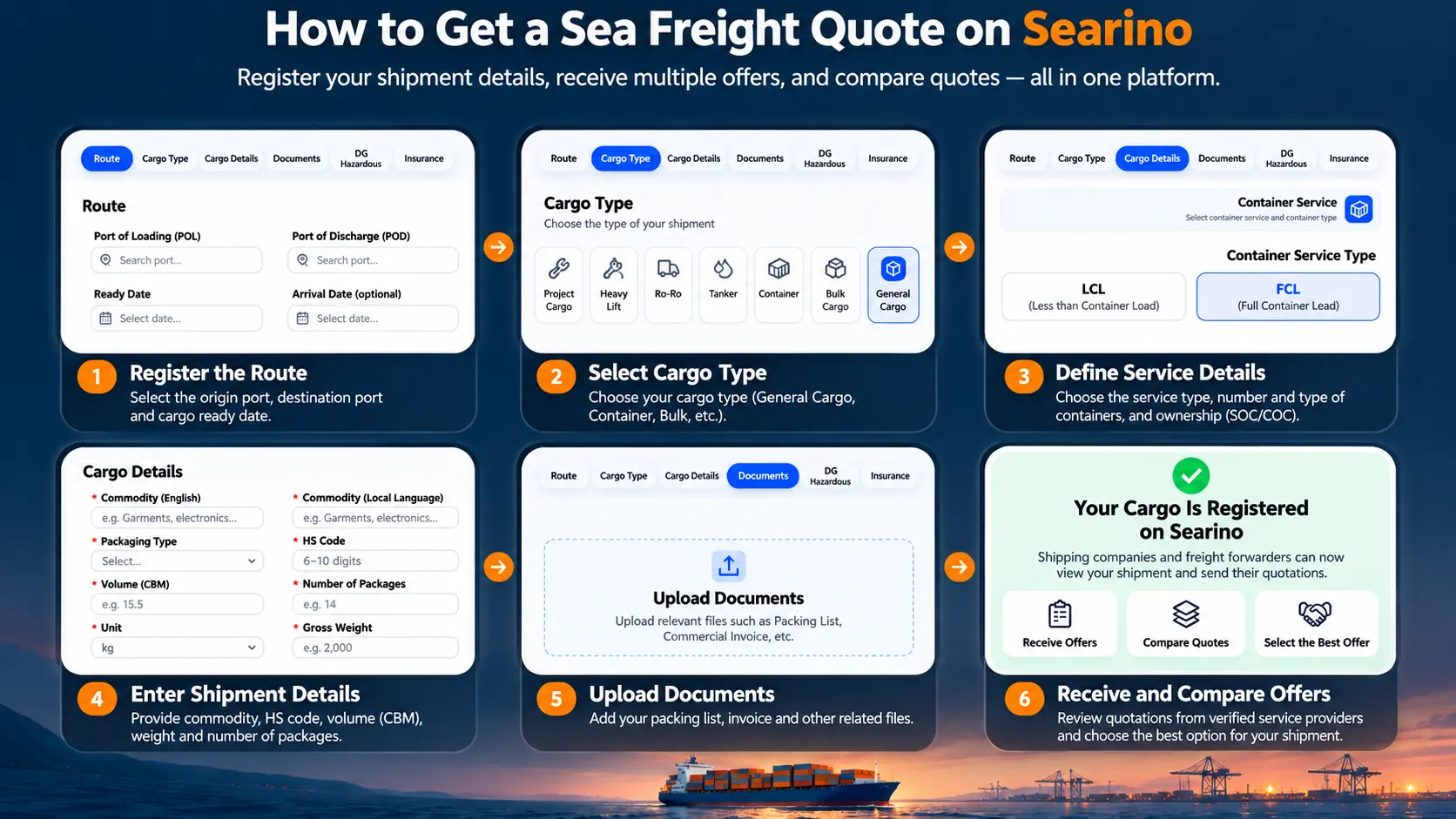
Cargo owners can submit their shipment details. Once the shipment is registered and displayed in the marketplace, shipping companies and freight forwarders can review the cargo specifications and submit their price quotations.
The cargo owner can then view the received offers, review their terms, and select a suitable provider.
Step 1: Register Your Shipment on Searino
First, visit the Searino platform and use the cargo registration section to enter your shipment details.
At this stage, you can provide information such as the origin and destination ports, cargo type, number of packages, weight, dimensions, volume, cargo readiness date, and any special requirements.
The more accurately you enter the information, the clearer the shipment details will be for service providers.
Step 2: Complete the Cargo Details and Upload Documents
On the shipment details page, you can enter additional information and upload documents related to your cargo.
For example, if your shipment consists of several pallets of industrial spare parts, provide the packaging details, weight, dimensions, and any available supporting documents.
This information is available to shipping companies and freight forwarders reviewing the shipment in the marketplace, helping them prepare more suitable quotations.
Step 3: Your Shipment Is Displayed in the Searino Freight Marketplace
After the initial registration, your shipment is listed in the Searino freight marketplace.
You can also access your registered shipments through the "My Shipments" section and view the details of each one.
The shipment details page displays information such as the route, cargo type, quantity, shipment specifications, and uploaded documents.
Step 4: Shipping Companies and Freight Forwarders Submit Quotations
Shipping companies and freight forwarders can review the available shipments in the marketplace and submit their price offers.
When submitting a quotation, the provider can enter the proposed amount, select the currency, provide vessel information, and add explanations or additional terms and conditions.
This means the proposed rate is based on the specifications of the actual shipment, rather than a general tariff that may not match your cargo requirements.
Step 5: Review and Compare the Received Offers
After receiving quotations, you can access the "Received Offers" section to view the prices submitted for your shipment.
This section allows you to review different offers and examine the amounts and descriptions provided by each service provider.
Before making a decision, consider more than just the quoted amount. Review the shipping route, service conditions, estimated transit time, and any potential additional charges.
Step 6: Accept or Reject the Offer
After reviewing the available quotations, you can accept or reject the offer that best suits your requirements.
Once an offer is selected, the booking process and transportation arrangements continue with the chosen service provider.
This allows shipment registration, marketplace listing, quotation submission, and offer review to take place within one platform.
What Are the Benefits of Searino's Freight Marketplace for Cargo Owners?
Instead of sending shipment details through multiple channels and collecting responses separately, you can view your freight request and related offers in one dedicated environment.
This makes it easier to organize and compare quotations and evaluate service providers with more complete information.
To get started, visit Searino.com and submit your shipment request.
Common Mistakes When Requesting Sea Freight Quotes
Even when you understand how freight rates are calculated, certain mistakes during the quotation process may result in offers that do not match the actual shipment requirements.
Providing Incomplete Cargo Weight and Volume Information
If you provide only the total cargo weight without specifying package dimensions, the shipping company may not be able to accurately assess the space required.
Always provide the number of packages, gross weight, and dimensions of each unit.
Not Specifying the Exact Origin and Destination Ports
Providing only the country names instead of the exact ports may create uncertainty when the shipping route is being evaluated.
For a more accurate quotation, specify the exact Port of Loading and Port of Discharge.
Focusing Only on the Basic Freight Rate
Sometimes the quoted amount covers only the basic ocean freight, while port charges, documentation, or destination services are calculated separately.
Before comparing prices, make sure you understand the scope of services included in each offer.
Not Declaring Special Cargo Requirements
If your shipment requires specialized equipment, temperature control, special packaging, or specific handling conditions, provide this information from the beginning.
Failing to disclose these requirements may lead to changes in the transportation arrangements or a revised quotation.
Choosing the Lowest Price Without Reviewing the Terms
A lower price does not automatically guarantee a better service.
Differences in the route, transit time, equipment, services, and excluded charges may change the overall value of each offer.
Frequently Asked Questions About Sea Freight Costs
How Are Sea Freight Costs Calculated?
Sea freight costs depend on factors such as the origin and destination ports, cargo type, shipment weight and volume, shipping method, available capacity, route conditions, and required services. The base freight rate, port charges, and additional expenses must also be considered when estimating the final cost.
Are Sea Freight Costs Calculated by Weight or Volume?
It depends on the type of service. For FCL container shipping, the base freight rate is generally determined by container type and size. For many LCL services, cargo weight and volume are assessed according to the applicable W/M tariff. For bulk and project cargo, tonnage, dimensions, and operational requirements are also important.
Why Do Shipping Companies Offer Different Rates for the Same Shipment?
Shipping companies may use different routes, vessel capacities, schedules, and operational arrangements. The scope of services and the charges included in their offers may also differ. Therefore, quotations should be compared based on similar services and conditions.
Does the Basic Ocean Freight Rate Include Port and Destination Charges?
Not necessarily. Some quotations cover only the basic ocean freight, while charges such as THC, documentation, storage, or destination services may be calculated separately. Always clarify the scope of services before accepting a quotation.
What Information Is Required to Request an Accurate Sea Freight Quote?
The main information includes the origin and destination ports, cargo type, number of packages, gross weight, dimensions, total volume, cargo readiness date, and any special shipment requirements. Documents such as packing lists and cargo photographs may also help when relevant.
How Are LCL Shipping Costs Determined?
In many LCL services, charges are calculated using a chargeable weight or volume basis known as W/M (Weight/Measurement). The service provider's tariff, minimum chargeable volume, and consolidation and deconsolidation charges should also be reviewed.
Are Sea Freight Rates Fixed?
No. Sea freight rates may change depending on available vessel capacity, shipping schedules, market demand, route conditions, and the cargo readiness date. It is best to request a quotation based on your actual shipment details and planned shipping date, and check its validity before booking.
How Can I Receive Quotations from Multiple Shipping Companies for One Shipment?
Through the Searino freight marketplace, you can register your shipment details so that shipping companies and freight forwarders can review the cargo and submit their quotations. You can then view and compare the received offers and accept or reject the option that best meets your requirements.
Conclusion: How to Estimate and Request Sea Freight Costs More Effectively
Sea freight costs are not based on a fixed amount or simply the distance between two ports. Cargo type, shipment weight and volume, shipping method, required equipment, available vessel capacity, route conditions, and port and additional charges all play a role in determining the freight rate.
To receive a more accurate quotation, prepare complete shipment information before making a request. Provide the route, cargo weight, volume, dimensions, and cargo readiness date accurately.
After receiving quotations, do not focus only on the final amount. Review the scope of services, estimated transit time, quote validity, and any charges excluded from the offer.
Through Searino's maritime freight platform, you can register your shipment details so that shipping companies and freight forwarders can submit their price quotations. You can then view and compare the received offers in your panel and select a suitable option based on the price and conditions of each proposal.
Register your shipment on Searino, receive quotations from shipping companies and freight forwarders, and compare the available offers to find a suitable shipping solution for your cargo.
Frequently asked questions
هزینه حمل دریایی به عواملی مانند بندر مبدأ و مقصد، نوع کالا، وزن و حجم محموله، روش حمل، ظرفیت موجود، شرایط مسیر و خدمات مورد نیاز بستگی دارد. کرایه پایه و هزینههای بندری و جانبی نیز باید در برآورد نهایی بررسی شوند.
این موضوع به نوع سرویس بستگی دارد. در حمل کانتینری FCL، کرایه پایه معمولا بر اساس نوع و سایز کانتینر تعیین میشود. در بسیاری از سرویسهای LCL، وزن و حجم محموله بر اساس تعرفه W/M بررسی میشوند. برای بار فله و پروژهای نیز تناژ، ابعاد و شرایط عملیاتی اهمیت دارند.
شرکتها ممکن است از مسیرها، ظرفیتها، برنامه حرکت و شرایط عملیاتی متفاوتی استفاده کنند. همچنین محدوده خدمات و هزینههای لحاظشده در پیشنهادها میتواند یکسان نباشد. به همین دلیل، مقایسه باید بر اساس خدمات و شرایط مشابه انجام شود.
خیر، لزوما اینطور نیست. بعضی پیشنهادها فقط کرایه اصلی حمل را شامل میشوند و هزینههایی مانند THC، خدمات اسنادی، انبارداری یا هزینههای مقصد جداگانه محاسبه میشوند. هنگام دریافت نرخ، محدوده خدمات را به صورت دقیق مشخص کنید.
بندر مبدأ و مقصد، نوع کالا، تعداد بستهها، وزن ناخالص، ابعاد، حجم کل، تاریخ آمادگی بار و شرایط ویژه محموله از اطلاعات اصلی هستند. ارائه مدارکی مانند پکینگ لیست و تصاویر بار نیز در صورت مرتبط بودن میتواند به بررسی بهتر کمک کند.
در بسیاری از سرویسهای LCL، هزینه بر اساس واحد قابل محاسبه وزن یا حجم (W/M) تعیین میشود. تعرفه ارائهدهنده، حداقل حجم قابل محاسبه و هزینههای تجمیع و تفکیک نیز باید بررسی شوند.
خیر. نرخ ممکن است با توجه به ظرفیت موجود، برنامه حرکت کشتی، تقاضای بازار، مسیر و تاریخ آماده بودن محموله تغییر کند. بهتر است پیشنهاد قیمت را برای مشخصات و زمان واقعی بار دریافت کنید و اعتبار آن را پیش از رزرو بررسی کنید.
در بازار بار سیرینو میتوانید مشخصات محموله را ثبت کنید تا شرکتهای کشتیرانی و فورواردرها بار را بررسی و پیشنهاد قیمت ارسال کنند. سپس پیشنهادهای دریافتی را مشاهده و مقایسه میکنید و میتوانید پیشنهاد مورد نظر خود را تایید یا رد کنید.


